


Pyoderma: Pimples, Pustules, Impetigo & Bacterial Skin Infections in Dogs
Remember, this is an educational resource, not a guide for diagnosis.
We always recommend consulting with your veterinarian.
Dealing with a bacterial skin infection?
Tap to jump to each section.
Photo Examples of Pyoderma in Dogs
Pyoderma (bacterial skin infection) manifests in many different shapes and forms. Please note: These photos are helpful, but they may not tell the complete dermatological story - or your dog's either.
-

Ringed lesions with dark centers on Siberian Husky's torso
-

Interdigital pyoderma (Staph infection) on English bulldog paw
-

Pustular outbreak on Great Dane's chin. Per the owner, this was chronic and due to underlying Addison's disease
-

Hot spot (surface pyoderma) on Bernedoodle foreleg
-

Pink bald patches with blisters and scabbing on Pitbull
-

Pyoderma with pink welts and scabbing on Corgi's hind paws
-

Pyoderma on a dog's hind legs, possibly instigated by parasites
-

Pyoderma outbreak on a dog's back. Note the red lesions and scabbing.
-

Thinning fur and scabbed lesion on side of dog's head
-

Impetigo (puppy pyoderma) on young Labrador's chest
-

Impetigo on young Staffordshire Bull Terrier (blur added)
-

Boston Terrier with thinning fur and scabbed lesion on its noggin
-

Yellow Labrador with pyoderma outbreak due to systemic infection
-

Red ring lesion (not ringworm) due to bacterial infection on dog's belly
-

French bulldog with systemic infection, seen with pyoderma and widespread alopecia
-

Shaved German Shepherd with systemic infection and pyoderma; underlying disorder is possible


-

No more infection or heating pad burn!
When I rescued Petunia, she had a burn on her back that got infected after a heating pad was left on for too long. This cleared the infection AND healed the burn in a few days. It's the BEST!
-- Michelle W.
-

Great for hot spots and pyoderma
A great product. Soothed hot spots and seemed to reduce itching. So much better than all the other products I’ve tried. My labrador has chronic pyoderma and this has been what has helped.
-- Pamela R.
-

A serious lifesaver for my dog
He was stung by a wasp under his arm, and then his underarm became quite raw and soon after, the opens sores from scratching got infected. After just 3 weeks of twice-daily application, his underarm has cleared up!
-- Natalie O.
-

Works great on scabs
My dog has very sensitive skin and gets cysts and bumps easily. He had one cyst that burst and would not heal. The scab was the size of a quarter with missing hair. Within a week of putting this on, it was completely gone!
-- A.C.
-

Stopped the itch and all healed up
My dog has a bump that she would constantly scratch and make it bleed and scab up. Ever since I have put this ointment on her, she has stopped itching and no more scab. All healed up!
-- Angel E.


RadiQuell™ Canine Puts Pyoderma to Pasture
-

Protecting Prong Collar Wounds
See what a nurse had to say -

Atopic Dermatitis + Pyoderma
See Samson's story -

Hot Spot + Scabbing
See Dunkin's story -

Paw Pyoderma
See Chandler's story -

Surface pyoderma (Hot spot)
See Bellini's story -

Infected Burn Wound
See Petunia's story


What is Pyoderma?
The term pyoderma means "pus in the skin," and it nearly always refers to a bacterial infection. It is predominantly caused by simple or complex bacterial infections.
Simple bacterial infections are brought about by one-time events, such as a scratch or hot spot. Complex infections are chronic and associated with underlying diseases or injury, such as skin allergies, severe burns, hormonal disorders, seborrhea, or parasites.
They are also often linked to wrinkly breeds that are prone to skin fold dermatitis (intertrigo).
It is possible for a secondary yeast infection to occur in addition to pyoderma, creating a compound infection.
Photo: Infection within a heating pad burn on dog's back; via customer

Key Identifiers of Pyoderma
Pyoderma can take on many forms and may not be obvious to identify without a proper diagnosis. That said, these are some of the most common symptoms:
- Red pustules, acne, or pimples filled with white or yellow pus
- Moderate to severe itching
- Excessive scaling, crusty and flaky skin
- Discharge, blood, or pus may be present
- Swelling, blisters, redness, and scabs
- Patchy fur loss, excessive shedding, and bald spots
- Welts around hairs (folliculitis)
- Foul odor is possible
- Pain and sensitivity

What Causes Pyoderma?
The vast majority of pyoderma cases are caused by bacteria called Staphylococcus pseudintermedius, which naturally dwells on canine skin. This species of Staph is a cousin to the Staph aureus that affects humans.
Like most opportunistic bacteria, 'Staph pseudi' is not inherently harmful until it can take advantage of a breach in the skin, set up a colony, and multiply -- hence the term "opportunistic."
Canine pyoderma is often a secondary effect to skin damage. A breach in the skin can be caused by cuts, scrapes, or licking and scratching at itchy skin affected by:
- Allergy dermatitis
- Hot spots
- Flea or tick bites
- Mange mites
- Cheyletiella mites
- Bee stings
- General dryness
- Poor grooming
Dogs with weakened immune systems, autoimmune disorders, or those undergoing chemotherapy can have a greater risk of acquiring pyoderma and having chronic infections.
Hormonal (endocrine) conditions, such as Cushing's disease or hypothyroidism, can also render dogs more susceptible. In these cases, pyoderma can lie dormant until triggered by the disorder or another factor.
Photo: Patchy fur loss on a vizsla's back due to superficial pyoderma triggered by Cushing's disease (according to owner); via u/Humble-Candle-9229 on Reddit

Where Does Pyoderma Typically Occur?
Like an itch or wound, bacterial infections of the skin can happen anywhere on a dog's body. That said, there are certain areas that bacteria are more prone to dwell.
Warm, moist, and protected areas such as wrinkles and skin folds, armpits, between toes and paw pads, groin, or under the tail make for ideal locations for bacteria (and yeast) to thrive.
Breeds with loose skin and skin folds are at a higher risk of developing intertrigo (skin fold dermatitis) and bacterial infection, as the constant rubbing of skin disrupts the epidermal barrier and maintains a warm environment that microbes love.
Pyoderma is classified into 3 categories based on the infection's depth: surface, superficial, or deep.
Photo: Wound with possible bacterial infection, caused by scratching at allergy dermatitis; via u/Charming-Payment-395 on Reddit

Surface Pyoderma
Surface pyoderma affects only the epidermis, the outermost layer of the skin. These tend to be mild, itchy, and the most treatable. Most hot spots (acute moist dermatitis) and skin fold infections (intertrigo) are considered forms of surface pyoderma.
If your dog is dealing with surface pyoderma (hot spots, allergy rash, wrinkle dermatitis, etc.), RadiQuell™ Canine can help resolve it.
Photo: Acute moist dermatitis on dog's leg; via u/holoVII on Reddit

Superficial Pyoderma
Superficial pyoderma is the most common form that is seen in dogs, reaching deeper within the epidermis to the hair follicles. It is also the most common reason for antimicrobial use among small animal practices.
Warm, moist areas of the skin, such as skin folds, armpits, groin, and interdigital areas, as well as pressure points -- like elbows and hocks (the "heel" of the hind leg) -- tend to be more prone to developing superficial pyoderma. It often appears as pustules around hair follicles (folliculitis), hair loss (alopecia), round, red lesions with a flaky edge, and crusty, scaly skin.
Photo: Superficial pyoderma lesions on dog; by Stephen White, DVM; via the Merck Veterinary Manual

Impetigo (Puppy Pyoderma)
Impetigo, commonly called "puppy pyoderma," is a form of superficial pyoderma that occurs in young dogs whose immune systems are still developing. It is generally noticed on the belly, inner hips, and around the genitals, though it can occur in other places.
Impetigo tends to look like clusters of red pimples or pustules with pus and yellow crusts or scabs forming.
As the dog matures, its immune system should overcome the infection. However, in cases where the infection does not resolve for a prolonged period, treatment might be advisable. RadiQuell™ Canine would work well agains puppy pyoderma, as it's extremely effective against Staph bacteria AND it's safe for dogs to lick.
Photo: Impetigo on young Labrador Retriever belly and inner hips; via u/QuietInformation1478 on Reddit

Deep Pyoderma
Pyoderma that involves the dermis -- the layer of skin beneath the epidermis -- and below is considered deep pyoderma. It is not as common as its superficial counterpart, but it is much more serious, as it brings a heightened risk of bacteria getting into the bloodstream (bacteremia). This can lead to a systemic infection that affects the entire body.
An area with deep pyoderma is often red, painful and sensitive, exhibiting crusting, bad odor, and discharging blood and pus. Acral lick granulomas, abscesses, and interdigital boils (furunculosis) are forms of deep pyoderma. Because these infections are more serious, they typically require both topical and systemic therapies (oral or injected) to clear the infection.
Photo: Lick granuloma with deep pyoderma, by Anthony Yu (V.A.D.E.R. Clinic); via Today's Veterinary Nurse
Dog Breeds Prone to Pyoderma
Any breed of dog can contract a bacterial skin infection, but dogs with excessive skin folds and thick fur tend to fall victim more than others.
-

Shar Peis
-

German Shepherds
-

English Bulldogs
-

Labradors
-

Pugs
-

Frenchies
-

Basset Hounds
-

Spaniels
-

Golden Retrievers


How Is Canine Pyoderma Diagnosed?
Pyoderma is typically identified after a physical examination and a skin cytology. This involves collecting a sample of skin, hair, crust, pus, or other material about the lesion and examining it under a microscope.
Skin cytology helps rule out other causes of inflamed hair follicles (folliculitis), such as demodicosis (a form of mange) or dermatophytosis (ringworm). A skin cytology can also help point out if there is an abundance of Malassezia fungi (yeast) on the skin, which commonly pairs with Staph bacteria to form a compound infection.
Bacterial cultures (as well as fungal, if fungi are present) may also be taken for testing if pyoderma is recurrent or serious. This is especially important as antibiotic resistant infections are becoming more prevalent.
Finally, because pyoderma often arises due to an underlying problem, other diagnostic tests may be conducted to discover what is triggering the infection -- whether allergies, parasites, cancer, or endocrine disorders. This is especially true in dogs that experience recurrent infections.
Photo: Pyoderma with red, scabby lesions on a dog's feet, legs, and belly. The ground-up range of the lesions could indicate a parasitic infestation initiated the infection; via u/DoYaFeelLuckyPunk on Reddit

How Is Pyoderma Treated in Dogs?
Medicated shampoos, ointments, soaks, and antiseptic washes are common. Antibiotics - both oral and topical - are typically reserved for serious cases, as antibiotic resistance is a big concern, especially for dogs with recurrent cases.
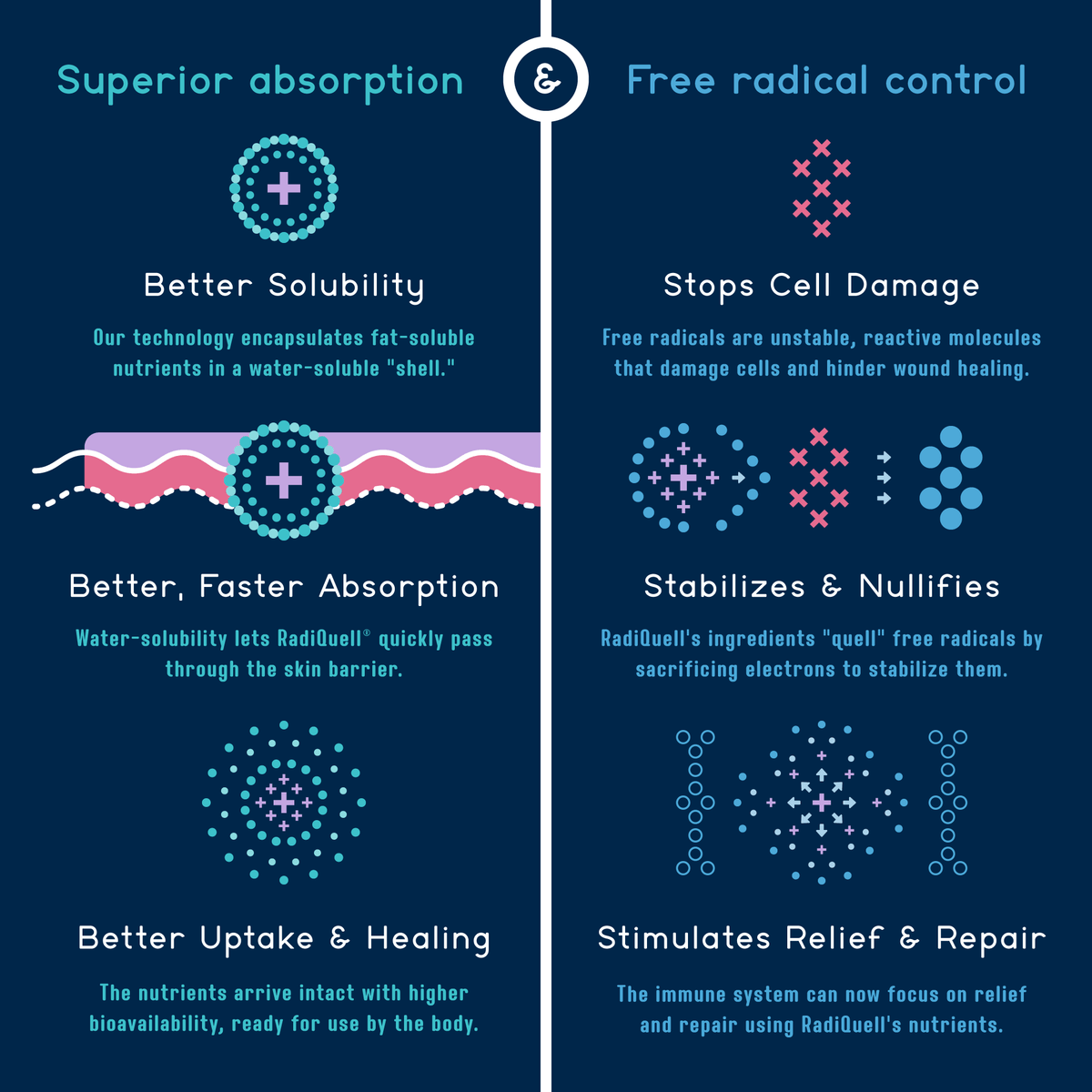
A very viable ointment option is our own RadiQuell™ Canine. It has a U.S. patent for its ability to inhibit and counter Staphylococcus bacteria -- both S. aureus in humans and S. pseudintermedius in dogs. Even their methicillin-resistant "superbug" forms (MRSA and MRSP) and their biofilms are highly susceptible to RadiQuell™ Canine.
RadiQuell™ Canine can not only help stop the infection, but also relieve sting and irritation that bacterial infections bring. And, because it's made with safe ingredients, it could be used in conjunction with antibiotics.
Photo: Red lesions due to generalized bacterial infection, via u/Seeriee3 on Reddit

Pyoderma Prevention & Infection Protection
Bacteria do not hesitate to invade damaged skin. Thus, it's always a good idea to treat your dog's wounds quickly and keep an eye out for excessive licking, chewing, and scratching at a single area. Here are some other things you can do:
- Keep some RadiQuell™ Canine on hand (obviously).
- Keep your dog's fur brushed and well-groomed.
- Bathe your dog regularly, being sure to wash those pits, ears, under the tail, and between toes and skin folds.
- Make sure they are thoroughly dry after bathing or being in water to prevent moisture from becoming trapped.
- Keep your dog's bedding and dishes clean.
- Make sure collars and harnesses aren’t too tight and allow appropriate air flow.
- Keep them on a flea prevention medicine, even during the cold months.
- If your dog has seasonal or environmental allergies, see your vet about an oral antihistamine regimen.
- Be aware of any food allergies your dog may have.
- Disallow them from agitating a specific spot; this may require booties, or an Elizabethan collar (cone).
Photo: Surface pyoderma (hot spot) on pitbull's throat, via customer
Not Sure What You’re Looking At?
Get our free photo ID guide with over 200 photos of real canine skin issues.


Pyoderma in Dogs FAQs
Can RadiQuell™ Canine help with my dog's pyoderma?
Absolutely.
RadiQuell™ Canine actually carries a patent for its ability to counter Staphylococcus bacteria, including Staphylococcus pseudintermedius, which is the primary cause of nearly all cases of canine pyoderma.
For cases that have become systemic (widespread), we would HIGHLY recommend a vet visit, as severe cases may require oral antibiotics to kill the bacteria in the bloodstream and throughout the body.
Is my dog's bacterial skin infection contagious?
It is rare that pyoderma is spread from dogs to humans, and good hygiene greatly minimizes the risk.
In nearly all cases, dogs develop pyoderma from a different species of Staphylococcus bacteria (S. pseudintermedius) than humans (S. aureus). It is possible, though very uncommon, for dogs to get an infection from S. aureus and humans to get an infection from S. pseudintermedius.
Humans, dogs, and other animals with weak or compromised immune systems are at a greater risk for contracting a bacterial infection.
Will my dog's bacterial skin infection go away on its own?
While it is possible that a healthy dog's immune system can fend off minor skin infection, it is by no means a guarantee. Dogs that are older, puppies, or those that have a weakened immune system are at greater risk of the infection to spread.
Bacterial skin infections left untreated can irreparably damage the area and / or become systemic -- meaning they get in the blood and move throughout the body. Systemic infections can create life-threatening consequences.
Does chronic pyoderma mean there is an underlying issue?
It is very possible, yes.
Dogs that get regular outbreaks of pyoderma tend to have an immune system that is somehow compromised. This could be due to:
- Bad seasonal allergies
- High sensitivity to an allergen they come into contact with regularly
- Food allergy, such as to chicken or corn
- Cushing's disease (hormonal disorder)
- Hypothyroidism
- Addison's disease
- Diabetes
- Autoimmune disorders
- Cancer and / or cancer treatments, such as chemotherapy
How can I tell if a bacterial infection is systemic?
Generally speaking, a systemic infection within a dog will result in:
- Outbreaks of lesions across the body
- Regular outbreaks of lesions in a specific area
- Chronic outbreaks that keep coming back, even after treatment
- Fur loss and excessive shedding
- Pain and sensitivity
- General sluggishness
- Loss of appetite
Systemic infections must be treated with antibiotics to eradicate the bacteria within the body. Unfortunately, regular use of antibiotics can create "super" strains of bacteria that are resistant to antibiotics.
Is dog pyoderma deadly?
Pyoderma is rarely deadly for healthy dogs and is not considered a serious threat to life unless the infection is complex and/or systemic.
Dogs with weak immune systems, autoimmune disorders, or other underlying diseases will be at more risk of developing a dangerous bacterial infection.
Another factor is bacterial antibiotic resistance. If the bacteria have become completely resistant to antibiotics and the dog's immune system, the outlook becomes much more bleak.
What does pus in my dogs wound mean?
Pus is a by-product of the battle between the body's white blood cells and an invading bacterial species.
In other words, the area is infected, and you should seek treatment for your dog.
How do you determine which type of pyoderma is present?
Pyoderma is characterized by the depth of the infection.
Surface pyoderma affects only the outermost layer of the skin (epidermis).
Superficial pyoderma breaks deeper within the epidermis to the hair follicles. It is the most common type.
Deep pyoderma breaches the dermis, or the layer of skin beneath the epidermis. It is the most serious, as it means bacteria are likely in the blood stream.
What bacteria causes pyoderma?
The vast majority of all cases of pyoderma in dogs are attributed to Staphylococcus pseudintermedius, a cousin to Staphylococcus aureus, which affects humans.
Is it possible for my dog have both a bacterial and fungal infection?
Yes, a compound infection of bacteria and fungi is possible.
In fact, Malassezia yeast infections tend to develop in tandem with a bacterial infection. Identifying exactly which microbes are present using skin cytology is key for veterinarians to diagnose and treat single and compound infections.

ARRIVING OCT 28!
Soothing Skin & Wound Serum for Dogs
Helps stop infection, relieve irritation, and repair damaged skin + fur.
Now in a 4x bigger size. You asked, we heard.
 FREE SHIPPING* ON ORDERS $35+
 30-DAY MONEY BACK GUARANTEE
 EVERY SALE HELPS DOGS + HEROES


More Dog Dermatological Disorders
-

Yeast Infections
This yeast is preferred leastOften secondary to bacterial infections, yeast infections can spread quickly, itch severely, and result in fur loss and blotchy skin.
-

Dog Hot Spots
Too hot to handle?Hot spots, also called acute moist dermatitis, are a notorious (but treatable) skin issue that affects millions of pooches each year.
-

Atopic Dermatitis & Allergies
Atopic worth studyingAtopic dermatitis is caused by a overly-sensitive immune system reaction to an allergen that creates inflammation and itching in the skin.


Collapsible content
Resources on canine pyoderma + our patent
RadiQuell™ Patent on Google Patents:
U.S. Patent #10,912,759: Topical Gel Compositions for the Treatment of Staphylococcal Infections
From our blog:
Other resources:
Photo credits
It takes considerable time and effort to compile diverse images of canine skin issues in order to make a helpful resource for pet parents.
There's no possible way to take all these ourselves, so we try to give photo credit whenever we can.
Top banner collage, left to right:
- u/Garvinjist (Reddit)
- u/Helpful_Mouse_9458 (Reddit)
- u/Traditional_Sail7873 (Reddit)
- u/Sleepyy_being (Reddit)
- u/DoYaFeelLuckyPunk (Reddit)
- u/Careful_Purchase_739 (Reddit)
- Customer photo
- u/Informal-Lab484 (Reddit)
- Customer photo
- u/RisefrmthAshes (Reddit)
- u/Woodberger (Reddit)
- u/brooksiecooksiee (Reddit)
- Customer photo
- u/Humble-Candle-9229 (Reddit)
- u/TheMrDanggas (Reddit)
- u/Charming-Payment-395 (Reddit)
- u/bandandboujee (Reddit)
- u/QuietInformation1478 (Reddit)
- u/Seerie3 (Reddit)
- u/International-Pin-32 (Reddit)
"Photo Examples of Pyoderma in Dogs" section, in order of appearance:
- u/Helpful_Mouse_9458 (Reddit)
- Customer photo
- u/Woodberger (Reddit)
- Customer photo
- u/Garvinjist (Reddit)
- u/bandandboujee (Reddit)
- u/DoYaFeelLuckyPunk (Reddit)
- u/Intelligent-Essay365 (Reddit)
- u/Charming-Payment-395 (Reddit)
- u/QuietInformation1478 (Reddit)
- u/Careful_Purchase_739 (Reddit)
- u/International-Pin-32 (Reddit)
- u/Informal-Lab484 (Reddit)
- u/RisefrmthAshes (Reddit)
- u/Traditional_Sail7873 (Reddit)
- u/brooksiecooksiee (Reddit)
"More Dog Dermatological Disorders" section:
- Yeast: Dr. Jangi Bajwa, DVM; via the Canadian Veterinary Journal
- Hot Spots: via Kingsdale Animal Hospital
- Atopic Dermatitis: via Family Pet Clinic of Menomonee Falls