


Canine Hot Spots: Pictures, Solutions, and Prevention
Remember, this is an educational resource, not a guide for diagnosis.
We always recommend consulting with your veterinarian.
Dealing with a Hot Spot?
Tap to jump to each section, including examples of hot spots and before / after photos using RadiQuell™ Canine.
Photo Examples of Hot Spots on Dogs
Below are several examples of what acute moist dermatitis on dogs can look like. Photo credits reside in the Resource dropdown at the bottom of the page.
-

Hot spot with underlying yeast infection
-

Hot spot on a Bernedoodle's foreleg
-

Hot spot on Shiba Inu's tail
-

Hot spot on top of a Labrador's head
-

Hot spot on top of dog's paw
-

Hot spots in German Shepherd front right axilla (armpit)
-

Hot spot on a Siberian Husky's groin
-

Hot spots on dog's back above the tail
-

Hot spot with scabbing on a dog's belly above genitals
-

Hot spot on side of chocolate Lab's face
-

Hot spots and fur loss on dog's tail
-

Hot spot under Golden Retriever ear
-

Hot spot on back of dog's front leg (fur shaven at vet)
-

Hot spots on side of Corgi's foot
-

Hot spot on dog's shoulder
-

Hot spot on dog's flank


RadiQuell™ Canine Heals Hot Spots


-

Radiquell's been a game-changer in treating hot spots and minor wounds.
-- K.P.
-

Healed my husky's hot spot quick!
-- Jennifer M.


What is a Hot Spot on a Dog?
Hot spots, also called acute moist dermatitis or pyotraumatic dermatitis, are red, inflamed, often shiny lesions created by consistent trauma to a specific area that gets infected -- most often by Staphylococcus (S. pseudintermedius) bacteria.
These raw, red areas are extremely itchy and can be very painful if left untreated. Hot spots are most commonly found around the head, neck, paws, hips, groin, and tail. Thinning or loss of fur are common in and around the spot.
Photo: Acute moist dermatitis on dog with curly fur, via u/lakiloe43 on Reddit

What Causes Hot Spots on Dogs?
Hot spots are created (and made worse) by a dog’s constant licking, biting, rubbing, or scratching at an itchy area.
Bacteria and / or yeast enter the broken skin and begin to multiply quickly, forming an infection and causing more irritation. It doesn't take long for a hot spot to show up on a dog -- many people remark that they seem to "appear overnight."
The initial instigating irritation could come from:
- Allergies (seasonal, environmental, or food-related)
- Fleas or ticks
- Cheyletiella mites
- Mange mites
- Insect bites
- Bee stings
- Injury, scrapes, razor burn from grooming
- Moisture trapped under the fur or between skin folds
- Persistent rubbing from a collar or harness.
Photo: Acute moist dermatitis on dog's hind leg, via u/blueberryJan on Reddit

Key Symptoms of Canine Hot Spots
- Red and inflamed area of skin or sores
- Skin appears to be raw and ‘angry’
- Pus, blood, or discharge may be present - signs of bacterial infection
- Hair loss (alopecia) and/or matted fur around the area
- Scabbing in and around the area
- Excessive licking and scratching at the area
- Your dog seems to be painful around this area

Can I Treat My Dog's Hot Spot at Home?
Yes! However, hot spots are best treated quickly before they can spread and more serious infection can develop.
If you notice your dog scratching at a specific area for a prolonged period, take a closer look. Like we mentioned above -- and like many skin problems in general -- the sooner you can catch acute moist dermatitis, the better.
Stopping the repeated agitation is key. The more dogs lick, chew, and scratch at a hot spot, the worse it gets, and the risk of developing a deeper pyoderma (bacterial infection) and/or a secondary yeast infection greatly increases. That's when things get expensive.
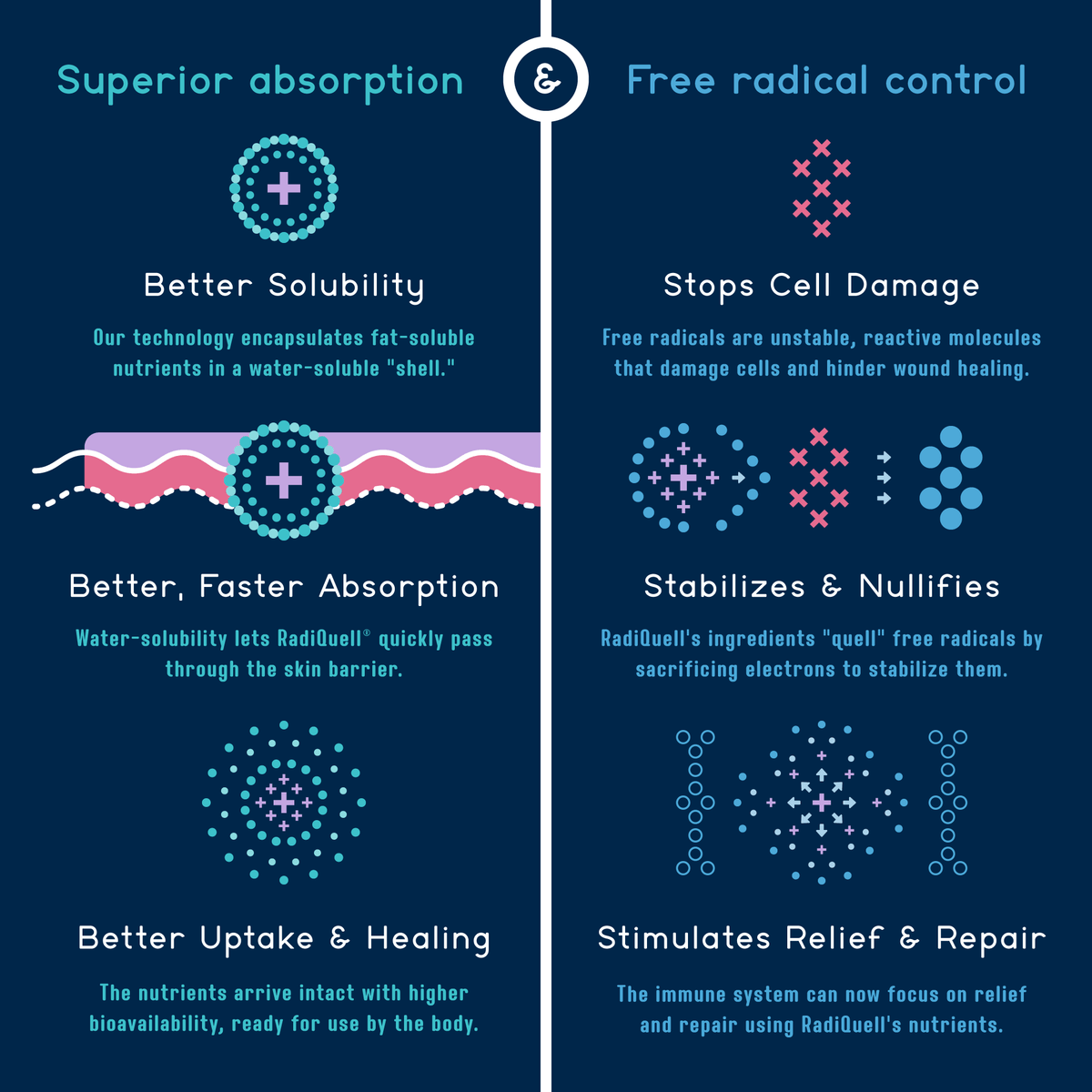
If you can relieve the discomfort that's causing all the "angst," you can stop a hot spot, and if you can provide protection from microbes, you can guard against infection. RadiQuell™ Canine covers both of those 'ifs.' Plus, it can tackle an existing infection while providing the necessary micronutrients to mend the damaged skin and regrow fur.
Photo: Hot spot with fur loss on dog paw, via u/bulletmagnettn on Reddit

The Simplest Way to Treat a Dog's Hot Spot
RadiQuell™ Canine is an excellent means of countering canine hot spots at any stage - even with infection.
Its natural lavender oil soothes the irritation and provides anti-inflammatory support, so dogs are less prone to itch and chew. Then, its powerful combination of antioxidants fight off microbes and provide the micronutrients needed to repair the damaged skin.
It's really as simple as these steps:
- Clean the area. Make sure the hot spot area is clean (chlorhexidine wipes can help). You may need to trim or shave excess fur in or around the area.
- Apply RadiQuell™ Canine.
- Distract your pup. Keep your dog from licking the product for a moment so it can absorb.
- (Optional, yet advisable) Apply a bandage and/or use a cone. This will depend on the hot spot's location or severity.
Photo: Hot spot on Golden Retriever neck, via u/Jaded-Trick7939 on Reddit
Dog Breeds Prone to Getting Hot Spots
Hot spots can happen to any breed of dog. They do tend to be more prevalent in dogs that live predominantly indoors, in breeds with thicker coats, or in those with numerous skin folds, such as:
-

Pitbulls
-

Rottweilers
-

Huskies
-

Pugs
-

Golden Retrievers
-

English Bulldogs
-

Akitas
-

German Shepherds
-

Frenchies
-

Yorkies
-

Labradors
-

Shih Tzus


How Do I Prevent Hot Spots?
Here are a few things you can do to keep acute moist dermatitis at bay:
- Use RadiQuell® Canine on itchy spots to help heal and prevent them from worsening.
- Keep your dog's fur well-groomed and trimmed, if needed.
- Wrinkly breeds should have skin folds cleaned regularly to guard against intertrigo.
- Make sure your dog is completely dry after a bath or being wet to prevent trapped moisture.
- Make sure collars and harnesses aren’t too tight and allow appropriate air flow.
- Keep them on a flea control/heartworm prevention medicine, even during the cold months.
- If your dog has seasonal or environmental skin allergies, see your vet about an oral antihistamine regimen.
- Be aware of any food allergies your dog may have.
- Disallow them from agitating a specific spot; this may require booties or an Elizabethan collar (cone or soft donut collar).
Photo: Hot spot on neck of Golden Retriever, via Kingsdale Animal Hospital
Not Sure What You’re Looking At?
Get our free photo ID guide with over 200 photos of real canine skin issues.


Dog Hot Spot FAQs
Does RadiQuell™ Canine help with hot spots?
Yup. Here's proof.
RadiQuell™ Canine is made with safe ingredients to help calm irritation quickly with lasting relief, keep the wound area moisturized, and provide the micronutrients needed to regrow skin and fur.
How do dogs get hot spots?
Hot spots come about due to excessive licking and scratching at a specific area. The initial cause of the itch could be nearly anything, but they are typically linked to:
- Seasonal or environmental skin allergies (atopy)
- Food allergies
- Parasitic bites (fleas, ticks, mites
- Bee or wasp stings
- Constant friction or rubbing from skin folds (intertrigo), clothing, collars, or harnesses
- Scrapes or wounds
- Razor burn from grooming
- Moisture trapped within the fur
- Anxiety
- Joint pain
Will my dog's hotspot go away on its own?
While it is possible for a dog's hot spot to go away on its own, it is unlikely, for it requires that the dog completely refrain from licking, scratching, or chewing at the area until the skin heals. If the hotspot is infected, there is a high probability that it will get worse if left untreated.
It is strongly recommended that hot spots are treated early and consistently until they are gone.
That's where RadiQuell™ Canine comes in. It's powerful enough to soothe itch and heal the inflamed skin while being safe enough for dogs to lick without fear of gastrointestinal upset.
Can my dog's hotspot get infected?
A hot spot is already an infection (Staph bacteria, in the majority of cases), generally referred to as superficial pyoderma.
A hot spot that is left untreated will generally spread and get worse. As a dog scratches to try to relieve the itch, it further damages the skin and exacerbates the infection.
It is strongly recommended that hot spots are treated early and consistently until they are gone, and RadiQuell™ Canine is a superb solution for that.
What if my dog's hot spot smells?
There aren't many spots continuously licked by a dog that will smell good, but if a dog's hot spot exhibits an especially foul odor, there's a good chance that a bacterial infection (also known as pyoderma) may be present.
What if my dog's hot spot has pus?
Pus in a dog's hot spot indicates pyoderma, or better known as a bacterial infection of the skin. It will need to be treated promptly, and you will certainly want to keep your dog from agitating it further.
Good news! RadiQuell™ Canine can be an immense help with pyoderma. Here's why:
The majority of canine bacterial infections in the skin are caused by Staphylococcus pseudintermedius - a cousin to Staph aureus that primarily affects humans. RadiQuell™ Canine has a U.S. patent - and multiple microbiology trials to back it - for its ability to hinder and kill Staph bacteria of both pseudintermedius and aureus species.
Are dog hot spots contagious?
No, canine hot spots are neither contagious to other dogs, nor humans.
However, it is possible that the original cause of the hot spot (what actually started the itch) can be spread, such as certain parasites like scabies mites, fleas, or ticks, or a fungal infection like ringworm.
Are dog hot spots fungal or bacterial?
Hot spots themselves aren't necessarily considered "fungal" or "bacterial," unless an infection has developed.
Hot spots are caused by repetitively licking and scratching an area of skin that's bothering them, which could have been caused by anything - a cut, bee sting, flea bites, allergies, or even anxiety.
The damaged skin of a hot spot makes a prime location for a bacterial infection (pyoderma) or fungal infection to develop. This adds to the irritation and makes dogs want to scratch and lick even more to soothe their skin, causing the lesion to grow.
Are dog hot spots dangerous?
Hot spots, like other skin wounds and disruptions, can become dangerous if they develop an infection. Infections, if left untreated, could spread and become systemic, affecting the whole body.
This is why it is best to treat a hot spot on your dog quickly with RadiQuell™ Canine. It will greatly aid in soothing the itch, healing the skin, and guarding against infection.
Will my dog's hair grow back after a hot spot?
Yes, it is very likely that your dog's fur will grow back after a hot spot, especially if they generally have healthy skin and coat.
It requires significant damage to the hair follicles and lower layer of skin (dermis) to deter a healthy dog's hair from regrowing.
Dogs with compromised immune systems, malnutrition, or other skin disorder may not be able to regrow hair as quickly or easily.
Are there any home remedies for dog hot spots?
Let's put it this way:
If you're willing to spend the money and time to buy and mix up a bunch of random ingredients and/or essential oils in your kitchen, we will save you both money and time with a product that's just as natural and safe, with over 15 years of research and thousands of happy dogs behind it. That's RadiQuell™ Canine.
-

Our fur baby is immensely better
We thought $20 is cheaper than a vet visit - let’s give it a try! So very thankful that we did. We have been using for 5 days and the itching has stopped. The redness is nearly gone and it is healing fantastically.
-- E.C.
-

Soothed my dog's hot spots immediately
My bulldog was getting the worst hot spots (something she's never had before! - turns out it was an allergic reaction to her wet food and probably something outside) but I found RadiQuell and it was a miracle! It started clearing up so fast! Even the vets highly recommended it.
-- Kristie H.
-

Soothed my dog's hot spots immediately
It helps my Shih Tzu with her hot spots caused by licking and scratching. It seems to start working almost immediately after being applied!
-- O.R.
-

Soothed my dog's hot spots immediately
"I have an 80lb Fawn Doberman who suffers with environmental allergies! She has a tendency to roll in grass and then excessively lick her paws and inner thighs on her hind legs. We needed an ointment for her hot spots. This definitely helped clear a lot of the redness. Does not irritate my dog at all and she doesn’t mind when I rub it on. She will not lick it either."
-- Kristen V.
-

Excellent, excellent product
Everyone needs this remarkable product. I used RadiQuell as an anti-itch ointment for my dog’s hot spots - much more effective than her oral meds from the vet. I will never be without it while traveling!
-- Joanne T.
-

No more hotspot and less itching
A great product. Soothed hot spots and seemed to reduce itching. So much better than all the other products I’ve tried. My labrador has chronic pyoderma and this has been what has helped.
-- Pamela R.
-

That hot spot disappeared fast
I used Radiquell on a hot spot on our dog and the spot cleared up within a couple of days. This stuff works so well. I keep telling everyone about it.
-- Melissa P.
-

Cured my dog's hotspot allergy
My dog had gotten like a really severe hot spot/allergic reaction to something. Had to trim her hair down and putting this on those hot spot areas did the trick!
-- Eliana


ARRIVING OCT 28!
Soothing Skin & Wound Serum for Dogs
Helps relieve + repair skin affected by hot spots, allergies, and more.
Now in a 4x bigger size. You asked, we heard.
 FREE SHIPPING* ON ORDERS $35+
 30-DAY MONEY BACK GUARANTEE
 EVERY SALE HELPS DOGS + HEROES


Related Canine Skin Issues
-

Rashes & Dermatitis
Ew... tell me moreDermatitis, or inflammation of the skin, comes in many different forms. We've compiled a list of 12 types with photos and descriptions.
-

Paw Licking & Irritations
The best foot forwardEver wonder why dogs lick their paws so much? Or why their feet can appear so red, inflamed, and itchy at times? We've got answers!
-

Bacterial Infections
See the bacterial materialAlso known as pyoderma, these skin infections often occur in conjunction with hotspots, as bacteria invade broken skin and multiply.


Collapsible content
Photo credits
It takes considerable time and effort to compile diverse images of canine skin issues in order to make a helpful resource for pet parents.
There's no possible way to take all these ourselves, so we try to give photo credit whenever we can.
Top banner collage, left to right:
- via Kingsdale Animal Hospital
- u/Spirited_Ad9924 (Reddit)
- Customer photo
- Customer photo
- u/lakiloe43 (Reddit)
- u/porterss25 (Reddit)
- u/christianovoxo (Reddit)
- Customer photo
- u/Straight-Key-4234 (Reddit)
- u/throwaway_acct217712 (Reddit)
- u/Jaded-Trick7939 (Reddit)
- u/Upbeat_Heart_9558 (Reddit)
- u/bulletmagnettn (Reddit)
- u/alexlovesmarijuana (Reddit)
- u/camntx003 (Reddit)
- Customer photo
- u/honeymariiee (Reddit)
- u/snowflakepr1ncess (Reddit)
- u/psychoKittten (Reddit)
- u/Wilsoa10 (Reddit)
"Photo Examples of Hot Spots on Dogs" section, in order of appearance:
- Customer photo
- Customer photo
- u/honeymariiee (Reddit)
- u/Visible_Summer_3174 (Reddit)
- u/Spirited_Ad9924 (Reddit)
- u/[deleted] (Reddit)
- Customer photo
- u/alexlovesmarijuana (Reddit)
- Customer photo
- u/porterss25 (Reddit)
- u/Straight-Key-4234 (Reddit)
- u/Wilsoa10 (Reddit)
- u/AventZyn (Reddit)
- u/Ducayne (Reddit)
- u/lostsoul_poly (Reddit)
- u/snowflakepr1ncess (Reddit)
"Related Canine Skin Issues" section:
- Rashes & Dermatitis: via Family Pet Clinic of Menomonee Falls(WI)
- Paw Licking: Customer photo
- Bacterial Infections: Customer photo