


12 Common Types of Dog Dermatitis & Rashes with Photos
Remember, this is an educational resource, not a guide for diagnosis.
We always recommend consulting with your veterinarian.
Is This What Your Dog is Dealing With?
Tap to jump to each section with more info. Use the bottom button to see before / afters using RadiQuell® Canine.


-

Finally, my dog has relief from itching
My 11yr old chocolate lab has been suffering from plaque psoriasis secondary to an autoimmune condition which took 5 months and 4 vets to diagnose. She has had little to no relief from the itching until now. I can't thank you enough.
-- Shelly
-

My Frenchie is allergic to everything
My Frenchie is allergic to all outside. He’s on shots, pills, shampoos, foods… and he still gets breakthrough itchiness. The ONLY thing that helps him is Radiquell.
-- Julie
-

This has changed life for us
My English Mastiff has chewed his front feet for years and I have lost count at how many thousands of dollars I have spent on trying to fix the problem. I came across RadiQuell and within 2 weeks there was such a difference. I have recommended it to everyone and have even taken some to my vet!
-- Louise
-

Customers for LIFE
My English Bulldog has allergies to many types of food and various environments. His flare-ups always result in skin rashes, loss of fur, and dermatitis. We gave this a shot, and we were truly AMAZED.
-- Michelle G.
-

Best stuff ever!
My bulldog was getting the worst hot spots (something she's never had before! - turns out it was an allergic reaction to her wet food and probably something outside) but I found RadiQuell and it was a miracle! It started clearing up so fast! Even the vets highly recommended it.
-- Kristie H.
-

No more food allergy rash
I removed the food and began to apply this ointment. It relieved the itch immediately. The next day when I went to apply more, my dog was wagging his tail because he knew relief was coming. The rash is healed!
-- Coty H.
-

Much better than other products I've tried
A great product. Soothed hot spots and seemed to reduce itching. My lab has chronic pyoderma and this has been what has helped.
-- Pamela R.
-

Soothes our senior dog's skin problems
RadiQuell has been such a wonderful find for us. Our 13 year old dog gets lots of skin problems and he used to lick them into major problems where we would have to put him into an e-collar to heal. Your gel soothes him.
-- Mary D.
-

Great stuff!
Pleasantly surprised at how quickly it worked; my dog has seasonal allergies and they're particularly worse this year. Radiquell worked almost immediately at calming the spots she was itching and prevented infection once applied.
-- Angela K.
-

Saved my dog from euthanasia
My Akita has been tormented by hotspots and episodes of atopic dermatitis with secondary yeast infections. At the end of his rope, we tried this. After a week, he started clearing up! It was nothing short of miraculous.
-- Roschelle H.


RadiQuell™ Canine Has Rashes & Dermatitis Covered
Real relief and results from our customers.
-

Yeast Dermatitis
Chubbs' Challenging Infection -

Acute Moist Dermatitis
Bellini's Bad Hot Spot -

Allergy Dermatitis
Piper's Grass Allergy Rash -

Contact Dermatitis
Soothing a Skin Reaction -

Pododermatitis
Chandler's Irritated Paw -

Severe Atopic Dermatitis
Samson's Atopy + Alopecia -

Allergy Rash & Irritation
A Pit Bull's Itchy Allergies -

Pyoderma
Petunia's Infected Burn -

Hot Spot & Pyoderma
Kierra's Sensitive Hot Spot


What is a Rash? And Dermatitis?
A rash is a temporary lesion of patchy, scaly skin that is often swollen, bumpy, red, and itchy. Rashes can arise on any part of a dog's body.
Though the terms are often used interchangeably, a rash is technically a result of dermatitis.
Dermatitis -- also referred to as eczema or atopy -- generally refers to inflammation of the skin. This inflammation is caused by the immune system's response to a perceived threat or irritant that is inhaled, ingested, or that breaches the skin barrier.
There are many different types of dermatitis, several of which we will explain below. Our product, RadiQuell™ Canine, can be of great help against many of them.
Whether our product can help or not, early detection and treatment are the way to go. The sooner that you seek a veterinary diagnosis and begin the proper prescribed treatment, the sooner you can get your fuzzy barking buddy back to normal.
Photo: Atopic dermatitis with possible yeast and / or bacterial infection, via u/mgarland0922 on Reddit
What Causes Rashes & Dermatitis in Dogs?
Dermatitis and rashes tend to develop and spread as your dog scratches at an initial itch or outbreak. They can form either as a direct reaction to, or by disrupting skin affected by the following:
-

Allergies
-

Flea, Tick & Insect Bites
-

Infection
-

Mites
-

Chemical Substances
-

Bee & Wasp Stings
-

Spider Bites
-

Injury & Friction
-

Cancer or Hormones


Acral Lick Dermatitis (Lick Granuloma)
Acral lick dermatitis, more commonly known as a lick granuloma, develops from constant licking and chewing at the same area. They are especially common on paws, legs, and tails.
The licking and chewing start due to an itch or discomfort, and the constant attention causes damage that can lead to a surface-level or deep bacterial infection with scarring. Sometimes, the licking is less about a physical itch and more of a compulsive habit.
Either way, for lick granulomas to go away, the licking must stop. A cone and/or bandage wrap with a soothing topical applied (i.e., RadiQuell™ Canine) along with anti-pruritic (itching) medications may be necessary to prevent further damage, provide comfort, and allow for the skin to heal.

Acute Moist Dermatitis (Hot Spot)
SEE MORE EXAMPLESAcute moist dermatitis, also called pyotraumatic dermatitis or, more commonly, "hot spot," is similar to acral lick dermatitis in that it appears and worsens after a dog licks, scratches, and chews at an itchy area. The area appears red, raw, and often shiny.
Hot spots can appear suddenly and arise due to allergies, cuts, bee stings, parasites, and other irritations. If left untreated, the broken skin and moist environment form a perfect breeding ground for bacteria and yeast.
Treating hot spots typically requires trimming the surrounding hair, cleaning the area, and applying a topical product that can relieve the itch, reduce inflammation, and counter bacteria. RadiQuell™ Canine covers all 3 of these needs and has a stellar track record against hot spots -- with thousands of dogs (and pet parents) finding the relief they need.
Take a much deeper dive into and see more photos of acute moist dermatitis on our Hot Spot Resource and our Ultimate Hotspot Guide.
Photo: Hot spot on neck of Golden Retriever, via Kingsdale Animal Hospital

Allergy & Atopic Dermatitis (Eczema)
SEE MORE EXAMPLESAs you might guess, allergy dermatitis stems from a specific allergen that your dog is sensitive to. It could be due to seasonal factors (pollen, dust, dry air), environmental factors (grass, chemicals, fleas, parasites, etc.), or food-related sensitivities (beef, dairy, chicken, wheat, etc).
More often than not, identifying a specific allergen can involve skin allergy tests, a blood test, and -- especially with food allergies -- a "trial and error" process of elimination. See our Complete Guide to Canine Food Allergies for more on that.
Atopic dermatitis (atopy, or atopic eczema) is the most common form of canine dermatitis and itching. It mainly comes about due to an allergen sensitivity, but in some cases, a genetically-predisposed immune system reaction may be the cause with no identifiable allergen.
Persistent itching (pruritis) is a key sign of atopy and allergic dermatitis, and you may notice pink or red lesions, flaky skin, and hair loss where the itching is most severe. Continuous scratching will lead to dark patches and thickened skin that appears leathery (lichenification).
Learn more about atopic dermatitis and skin allergies (and see more examples) in our Atopy + Skin Allergy Resource.
Photo: Atopic dermatitis with missing fur on face and feet, via Family Pet Clinic of Menomonee Falls

Contact Dermatitis
SEE HOW WE HELPED THIS DOGContact dermatitis is very similar to allergy dermatitis. It comes about when the skin comes into contact with a specific irritant, such as an allergen or a chemical substance like floor cleaners or pesticides.
This form of dermatitis may also arise from friction. Collars and harnesses that are too tight or do not allow proper air flow can irritate the skin and generate a contact rash. However, these lesions tend to be short-lived if the area is treated topically and left alone.
Photo: Red lesion on a male dog's hip, due to a reaction to chlorhexidine, a wound-sterilizing agent; via customer

Folliculitis
Folliculitis refers to inflammation of a hair follicle due to an irritation. This may appear as white / yellow pimples, red bumps, small sores, or scabs on the dog's skin. In certain cases where the hair follicle sustains significant damage, a follicular cyst may appear.
Bacteria is the most common cause of folliculitis -- especially Staphylococcus bacteria; this can also be referred to as superficial pyoderma. Other causes can be excess rubbing or scratching, fungi, or parasites.
Based on our microbiological and anecdotal data, RadiQuell™ Canine would be an effective option against both folliculitis and superficial pyoderma.
Photo by Dr. Marie-Christine Cadiergues, via Douxo UK

Intertrigo (Skin Fold Dermatitis)
SEE MORE EXAMPLESIntertrigo, or skin fold dermatitis, involves inflammation and irritation caused by friction between folds of a dog's skin. It is further exacerbated by allergies and the overgrowth of microbes that thrive in these areas.
Skin fold dermatitis can affect the facial folds (especially in brachycephalic "bully" breeds), lip folds, neck and body folds (Basset hounds and Shar Peis), tail folds (esp. in dogs with corkscrew tails), scrotal, and vulval folds. It is highly recommended that wrinkly dog breeds have skin folds kept clean to reduce the risk of developing intertrigo.
Untreated intertrigo carries a strong chance of developing yeast infection (Malassezia) and/or bacterial infection (pyoderma). As we've mentioned -- this is our domain, after all -- RadiQuell™ Canine can be a big help in reducing irritation and microbial burden to help heal areas affected by skin fold dermatitis.
Check out our Skin Fold Dermatitis Resource for more info and photo examples.
Photo: Facial fold dermatitis in nasal fold of a French Bulldog, via u/ADM1227 on Reddit

Malassezia Dermatitis (Yeast)
SEE MORE EXAMPLESCanine yeast infections of the skin are also called Malassezia dermatitis -- after the Malassezia pachydermatis yeast that causes them. This yeast generally resides on dogs' skin and is harmless until an overgrowth occurs.
Yeast dermatitis is quite common in dogs, and is not contagious. It can happen as a secondary condition to allergies, a compromised immune system, or due to increased humidity or oils produced by the skin.
Typical signs of yeast dermatitis are severe itching, redness, thickened, crusty skin with darkened pigmentation, and an unpleasant musty odor. Treatment of Malassezia dermatitis typically includes medicated shampoos and topical products (like ours), with oral meds given for severe or persistent cases.
See more examples and get more info on yeast infections in our Malassezia Dermatitis Resource.
Photo: Malassezia (yeast) dermatitis on small dog's throat and chest, with fur loss, hardened, leathery skin, and black spots, by Jangi Bajwa, DVM; via the Canadian Veterinary Journal.

Mange
Mange refers to a skin disease caused by two different species of microscopic mites: demodectic (demodex) and sarcoptic (scabies).
Demodectic mange is the most common type seen, typically affecting puppies and older dogs with a compromised immune system. Demodex mites live in and attack the hair follicles, leading to hair loss. This form of mange is noncontagious, but it can be genetically transmitted.
Sarcoptic mange, also called scabies, is both extremely contagious and horribly itchy. These mites burrow into the skin and bring about redness, hair loss, dark spots on the skin, and scabs. They are typically picked up from other animals already carrying them.
A combination of topicals, medicated baths and oral drugs are often employed to get rid of mange. We currently do not know if RadiQuell™ Canine is helpful against the mites themselves. However, we have two testimonies reporting that it was a massive help to relieve the itching and restoring the skin of dogs affected by both forms of mange.
See our Mange Resource for more information and pictures that are, frankly, hard to look at.
Photo: Dog with severe inflammation, scabbing, and lichenification (skin hardening) due to demodectic mange; via customer

Pododermatitis (Irritated Paws)
SEE MORE PAW PROBLEMSPododermatitis refers to dermatitis of the feet / paws. The paws are one of the most common areas that dogs develop dermatitis, especially when allergies flare up.
Dog paws come into constant contact with diverse surfaces and substances, and while they tend to be hardy, their skin can become damaged and irritated by allergens and microbes. By nature, dog paws are excellent breeding grounds for bacteria and yeast, which love dark, closed areas.
When the skin is damaged or broken, the pre-dwelling microbes are quick to move in and establish an infection. This creates inflammation and itch, which leads to a self-sustaining cycle of excessive licking and chewing that further damages the skin and makes things worse.
Pododermatitis is another area where RadiQuell™ Canine can be of help in reducing irritation and microbial burden while being safe if ingested. It should be noted that some dogs will be more determined to lick their feet than others, so regardless of treatment, they will need to leave the area alone so it can heal.
Learn more about pododermatitis and the many reasons why dogs lick their paws in our Pododermatitis / Dog Paw Licking Resource.
Photo: Pododermatitis with redness between paw pads and hot spot; via u/William_Dafhoe on Reddit

Pyoderma (Bacterial Skin Infection)
SEE MORE EXAMPLESPyoderma is another name for a bacterial skin infection. In young puppies, it can be referred to as impetigo.
Pyoderma takes on many forms: pustules, pimples, red-ringed lesions, round sores with a crusty edge, or even fur loss with scabs that can be patchy or extensive. As a general note, if there is pus or yellowish scabbing present, pyoderma is likely present.
When the skin is damaged or broken, bacteria -- most commonly Staphylococcus -- settle into the area and form an infection. Prime locations for pyoderma are under collars, under the tail and hips, and between skin folds, where there is constant contact and a warm, dark, moist environment.
As with any infection, earlier treatment yields faster results. The longer an infection is established, the harder it can be to eliminate due to the formation of bacterial biofilms.
RadiQuell™ Canine can be an immense help against pyoderma, as it carries a patent for its ability to counter Staphylococcus bacteria (and their biofilms), the culprit behind nearly all cases of canine pyoderma.
Learn more about pyoderma and see examples in our Pyoderma Resource.
Photo: Lesions on dog shoulder with likely bacterial infection; via u/DoYaFeelLuckyPunk on Reddit

Ringworm
In spite of its name, ringworm is not a worm or parasite, but a fungal infection. Its formal name is dermatophytosis, after the dermatophyte fungi that cause it. These fungi are highly contagious and can even be spread to humans. Dogs that are diagnosed with ringworm should be kept isolated from other pets and people during treatment.
With humans, ringworm appears on the skin as circular or ovular red lesions that are surrounded by scaly skin. In dogs, these lesions may have circular or amorphous patches of hair loss, with redness, dark patches, and scaly skin. Ringworm can also develop in dogs' toenails as well.
Topicals and oral antifungals are typically used to treat ringworm over a period of several weeks or months, and any contaminated areas or articles (where the fungal spores may reside) should be thoroughly disinfected or discarded.
Head over to our Canine Ringworm Resource for more information and image examples.
Photo: Ringworm lesion on dog's back; via u/Illustrious-Tea-7227 on Reddit

Seborrhea
Seborrhea is a skin condition causing scaly, flaky, red, and itchy skin. It occurs due to an abnormal level of keratin production -- a protein that forms skin, nails, paw pads, and hair.
Seborrhea comes in two forms: seborrhea sicca (dry) and seborrhea oleosa (oily), though many dogs with this kind of dermatitis have both forms. Possible symptoms can include a dry, lackluster coat, excessive dandruff, odorous, greasy skin, rough and scaly skin lesions, and large amounts of earwax and ear debris.
Seborrhea is considered a primary or secondary disease. The primary form is inherited genetically. The secondary form, which is more common, arises in relation to an underlying issue, such as a hormonal imbalance, allergies, parasites, infection, malnutrition, or environmental factors.
There is no specific treatment for primary seborrhea, but there are ways to help mange it. Treating secondary seborrhea technically involves finding and treating its underlying cause. Some general forms of managing seborrhea include Omega-3 supplements, shampoos, sprays, corticosteroids, and antibiotics/anti-fungals to counter secondary infections.
See our Canine Seborrhea Resource for more information and examples of what it can look like.
Photo: Seborrhea with crusts on dog's throat; via Getty Images
Not Sure What You’re Looking At?
Get our free photo ID guide with over 200 photos of real canine skin issues.


Dog Dermatitis FAQs
What is dermatitis in dogs?
Dermatitis refers to inflammation in the skin caused by the immune system's response to perceived foreign substances (e.g., allergens, bacteria, etc.) that have penetrated the skin barrier or entered the body via inhalation or ingestion.
The inflammation can cause localized (single area) or generalized (all over) itching varying from minor to extreme, depending on a dog's sensitivity to the invading substance. As itching continues, redness, rash, and infection can appear and exacerbate the problem.
In dogs with autoimmune disorders, the immune system attacks the body, viewing normal cells as harmful and triggering chronic inflammation. Lesions may manifest in certain areas, often referred to as psoriasis.
Can RadiQuell™ Canine help with my dog's dermatitis?
Yes, RadiQuell™ Canine (RQC) can be helpful against many, if not all, forms of canine dermatitis.
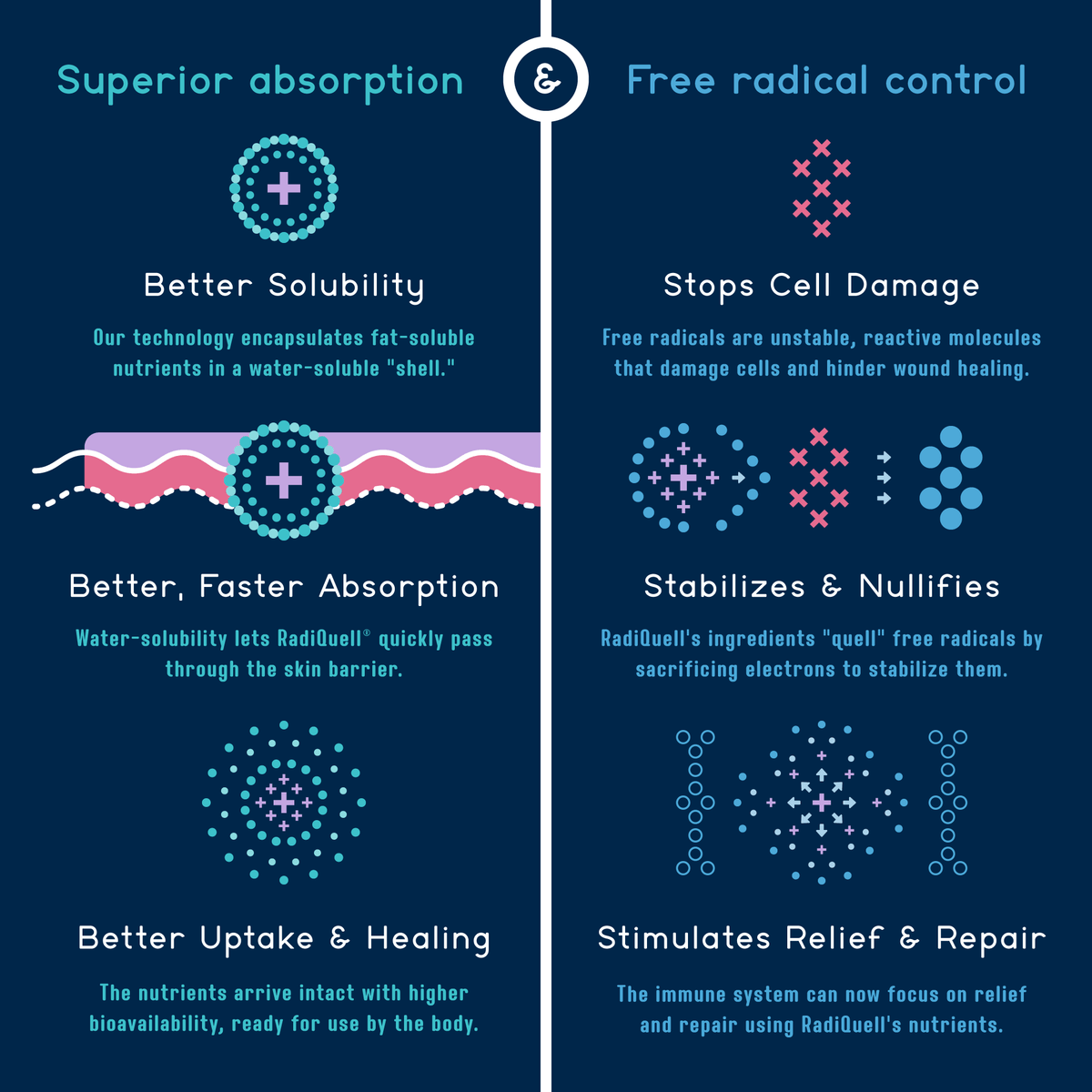
RQC's ingredients work quickly and naturally to calm irritation and heal skin by:
- Quenching free radicals that exacerbate inflammation (the cause of discomfort)
- Countering microbial activity, as bacteria and fungi create a greater problem for the immune system (and more inflammation)
- Providing the necessary nutrients for skin repair.
What causes dermatitis in dogs?
Dermatitis is caused by the body's inflammatory response to a substance that the immune system determines to be harmful to the body. This inflammatory response triggers an itching sensation ranging from mild to overwhelming.
Some potential culprits for this reaction are:
- Seasonal or environmental allergens, such as pollen, mold, dust mites, dander
- Food allergies (less common than seasonal/environmental)
- Injury, friction, or repetitive scratching, licking, or rubbing
- Parasitic bites, such as fleas, ticks, mosquitoes, and mites
- Bacterial infection (pyoderma)
- Yeast infection (Malassezia)
- Ringworm (dermatophytosis)
- Insect bites
- Spider bites
- Bee or wasp stings
- Chemical substances (cleaning supplies, paint, cosmetics, etc.)
- Hormonal disorders
- Autoimmune disorders
- Certain cancers
How is dermatitis in dogs treated?
Treatment for canine dermatitis will depend on the specific type of dermatitis and any underlying conditions.
There is no one-size-fits-all cure or medication, but there are several methods that are generally provided to do these things: reduce inflammation, prevent or stop infection, remove parasites (if applicable), and restore the skin.
Reducing inflammation
- Antihistamines
- Corticosteroids
- Injections (oclacitinib or lokivetmab)
- Topical products
- Omega-3 supplementation (longer-term management)
Preventing or stopping infection
- Antibacterial/anti-fungal shampoos
- Prescription creams and ointments (such as RadiQuell™ Canine)
- Systemic oral medications -- though these are not used often due to risk of developing antibiotic resistance
Removing parasites
- Medicated baths
- Topical creams
- Oral medications
Restoring damaged skin
- Moisturizing shampoos, creams (hint: RadiQuell™ Canine), and balms
In some cases, the dermatitis cannot be fully cured but must be managed for the life of the dog. Examples of this could be primary seborrhea, autoimmune-related psoriasis, or chronic skin allergies.
What is acute moist dermatitis?
Acute moist dermatitis, or pyotraumatic dermatitis, is fancy term for "hot spot."
Hot spots are caused, and made worse, by scratching, licking, chewing, and rubbing at an area until it becomes red, raw, and often shiny.
The initial itching that brings about acute moist dermatitis can be brought about by a plethora of different causes.
See our Hot Spot Resource for more info than you may ever want on this topic.
What's the difference between acral lick dermatitis and acute moist dermatitis?
Acral lick dermatitis is caused exclusively by licking and chewing, whereas acute moist dermatitis (hot spots) can be caused by licking, chewing, scratching, rubbing, or other forms of trauma. Many times they are used interchangeably.
Both result in fur loss and an ugly sore that gets invaded by Staphylococcus bacteria, forming a localized infection. Hot spots and lick granulomas are classified as superficial pyoderma (bacterial infection).
Both forms of dermatitis are largely self-inflicted. To get the sore (lick granuloma or hot spot) to go away, the area must be left alone and allowed to heal. RadiQuell™ Canine can be a big help for both forms.
See our Hot Spot Resource for more info on this topic.
What is atopic dermatitis in dogs?
Atopic dermatitis, or atopy, refers to dermatitis (inflammation of the skin) brought about by the immune system's reaction to an allergen.
Also referred to as allergy dermatitis, atopy is the most common form of dermatitis in dogs, and the itching that it brings tends to lead to more severe forms of dermatitis.
Allergens can be quite general or specific to each breed -- or even to each dog!
See our Dog Skin Allergies Resource for a thorough examination of what can cause canine skin allergies, what they can look like, and how they are tested for and treated.
What is contact dermatitis in dogs?
Contact dermatitis is inflammation in the skin (often seen as a rash) that is caused by the skin coming into contact with an irritant, such as chemicals or pollen, or by friction.
What is folliculitis in dogs?
Folliculitis is simply an inflamed hair follicle(s), which is usually resembles zits, red bumps, or scabs with a hair in the middle.
Folliculitis is typically a form of superficial pyoderma -- or an infection caused by bacteria. Though less common, a fungal infection can result in folliculitis as well.
What is intertrigo in dogs?
Intertrigo, also known as skin fold dermatitis, is created by friction between skin folds, and made worse by bacteria and/or fungi.
Brachycephalic breeds ("smoosh-faced," to be technical) such as bulldogs, breeds with numerous skin folds such as Basset hounds and Shar Peis, and obese dogs carry a higher risk of intertrigo.
See our Skin Fold Dermatitis Resource for more info, including photo examples and how to care for intertrigo.
What is Malassezia / yeast dermatitis in dogs?
Yeast dermatitis in dogs is inflammation of the skin caused by a sensitivity to, or an overabundance of, yeast in a dog's skin.
Nearly all canine yeast infections (skin and ears) are caused by a fungus called Malassezia pachydermatis. These fungal infections often occur in tandem with a bacterial infection and can be very difficult to get rid of.
See our Malassezia Dermatitis Resource for more information, including photo examples, and how yeast dermatitis is diagnosed and treated.
What is mange in dogs?
Mange is a skin condition caused by an infestation of parasitic mites. There are two types: demodectic mites and sarcoptic mites.
The infestation of these mites can open the door to infection and systemic complications.
We go into much more detail on this serious skin disease in our Canine Mange Resource.
What is pyoderma in dogs?
Pyoderma is Latin for "pus in the skin," and it nearly always refers to a bacterial skin infection.
Pyoderma can be very itchy and get very ugly if not properly treated. It can even prove fatal if the infection progresses to a systemic level.
Check out our Canine Pyoderma Resource to learn about the different types, the bacteria behind ~99% of all cases, and how it can be treated.
What is ringworm in dogs?
Ringworm, also referred to as dermatophytosis, is a skin disease caused by three different species of fungi that feed on hair follicles.
Ringworm can take considerable time and effort to treat. The culprit fungi are zoonotic, highly contagious, and can live on abiotic surfaces for over a year, requiring a thorough cleaning of an infected animal's environment.
Check out our Canine Ringworm Resource for a deep dive into this stubborn skin condition.
What is seborrhea in dogs?
Seborrhea, or seborrheic dermatitis, is a skin condition that occurs due to an abnormal level (typically an overabundance) of keratin production in the skin.
Symptoms can include a dry, lackluster coat, excessive dandruff, greasy skin with bad odor, scaly skin lesions, and large amounts of earwax and ear debris.
Seborrhea can be a primary (genetically inherited) or secondary disease, meaning it is brought about by another issue, such as allergies, parasites, infection, or others.
Check out our Seborrhea in Dogs Resource to learn more.

ARRIVING OCT 28!
Soothing Skin & Wound Serum for Dogs
Helps relieve itch + repair irritated or damaged skin.
Now in a 4x bigger size. You asked, we heard.
 FREE SHIPPING* ON ORDERS $35+
 30-DAY MONEY BACK GUARANTEE
 EVERY SALE HELPS DOGS + HEROES



Collapsible content
Resources
Atopic Dermatitis:
- Merck Veterinary Manual: Canine Atopic Dermatitis
- Cornell University Riney Canine Health Center: Atopic Dermatitis (Atopy)
- Current Knowledge on Canine Atopic Dermatitis: Pathogenesis and Treatment
Acute Moist Dermatitis:
Intertrigo (Skin Fold Dermatitis):
Dan G. O'Neill, Dara Rowe, Dave C. Brodbelt, Camilla Pegram, Anke Hendricks; 2022: Published by: Scientific Reports, July 6, 2022, 12(1):10553; PMID: 35794173; PMCID: PMC9259571.
Malassezia (Yeast):
Bajwa J, 2017 Oct; 58(10): p. 1119-1121
Mange:
- Cornell University Riney Canine Health Center: Sarcoptic Mange (Scabies)
- VCA Animal Hospitals: Demodectic Mange in Dogs
- VCA Animal Hospitals: Sarcoptic Mange in Dogs
- Merck Veterinary Manual: Mange in Dogs and Cats
Pyoderma:
RadiQuell™ Patent on Google Patents:
U.S. Patent #10,912,759: Topical Gel Compositions for the Treatment of Staphylococcal Infections
From our blog:
Other pyoderma resources:
- Canadian Veterinary Journal: Canine Superficial Pyoderma and Therapeutic Considerations
- VCA Animal Hospitals: Pyoderma in Dogs
Ringworm:
Seborrhea:
Photo credits
It takes considerable time and effort to compile diverse images of canine skin issues in order to make a helpful resource for pet parents.
There's no possible way to take all these ourselves, so we try to give photo credit whenever we can.
Top banner collage, left to right:
- u/holovii (Reddit)
- Customer photo
- via Family Pet Clinic of Menomonee Falls
- u/SensitiveNatural7616 (Reddit)
- by Dr. Marie-Christine Cadiergues; via Duoxo UK
- u/blueyintheus (Reddit)
- via Willows Veterinary Centre & Referral Service
- Customer photo
- Customer photo
- Customer photo
- u/Illustrious-Tea-7227 (Reddit)
- u/luna8tuna (Reddit)
"Is This What Your Dog is Dealing With?" section:
- Hot Spot: Customer photo
- Pyoderma: u/DoYaFeelLuckyPunk (Reddit)
- Skin Allergies: Family Pet Clinic of Menomonee Falls
- Skin Reaction: Customer photo
- Yeast: Willows Veterinary Centre & Referral Service
- Intertrigo: u/ADM1277 (Reddit)
- Folliculitis: by Dr. Marie-Christine Cadiergues; via Duoxo UK
- Mange: Customer photo
- Lick granuloma: u/holovii (Reddit)
- Irritated Paws: Customer photo
- Ringworm: u/Illustrious-Tea-7227 (Reddit)
- Seborrhea: via Getty Images